Jumeirah Mosque, UAE | Visiting Guide, History, Tours & Dress Code
Few landmarks in Dubai embody the city’s commitment to cultural openness as clearly as Jumeirah Mosque. Built at a time when Dubai was rapidly transforming from a coastal trading settlement into a global city, the mosque stands today not only as a place of worship but as one of the Middle East’s most successful models of cultural dialogue. It is among the very few mosques in the UAE that systematically welcome non-Muslim visitors—an intentional decision that has shaped how millions of travelers understand Islam, Emirati traditions, and Dubai’s social fabric.
For travelers seeking context beyond skyscrapers and shopping malls, Jumeirah Mosque offers something rarer: meaningful access to living culture, presented with clarity, warmth, and intellectual depth.
A Mosque Born with Modern Dubai
Construction of Jumeirah Mosque began in 1975 and was completed in 1979, during the pivotal “oil era” when Dubai’s urban identity was taking form. The mosque was commissioned by Sheikh Rashid bin Saeed Al Maktoum, the former Ruler of Dubai, as a personal gift to his son and heir, Sheikh Mohammed bin Rashid Al Maktoum, who would later become Vice President and Prime Minister of the UAE and Ruler of Dubai.
The project was entrusted to Hegazy Engineering Consultancy, led by architects Abd al-Muʿizz Husayn and Muhammad al-Mahdi Hegazy, whose Cairo-based practice was deeply influenced by classical Islamic architecture. This explains why Jumeirah Mosque does not imitate Gulf vernacular mosques, but instead references architectural traditions from Fatimid and Mamluk Cairo—styles historically associated with learning, governance, and public life.
In its early years, the mosque also served as the headquarters of the Sheikh Mohammed Centre for Cultural Understanding (SMCCU), reinforcing its role as an educational and outreach institution rather than a purely devotional space.
Location & Urban Setting
Jumeirah Mosque is located on Jumeirah Beach Road (D94) in Jumeirah 1, one of Dubai’s most established coastal neighborhoods. This area is characterized by:
- Low-rise residential villas
- Diplomatic missions and embassies
- Proximity to beaches and cultural landmarks
- A diverse expatriate population
The mosque’s placement is deliberate. Jumeirah Beach Road connects historic districts like Bur Dubai with newer coastal developments, positioning the mosque as a cultural bridge—both geographically and symbolically.
Nearby landmarks include:
- Etihad Museum (UAE nation-building history)
- La Mer beachfront district
- Mercato Mall
- Dubai Canal access points
For readers exploring Dubai’s older quarters, you may also find it useful to read about Al Fahidi Historical Neighbourhood and Dubai Creek on aboutdubai.online, both of which contextualize the city’s pre-oil heritage.
Recommended: Dubai Aquarium
Architectural Identity: Fatimid Grandeur with Mamluk Detail
Exterior Design
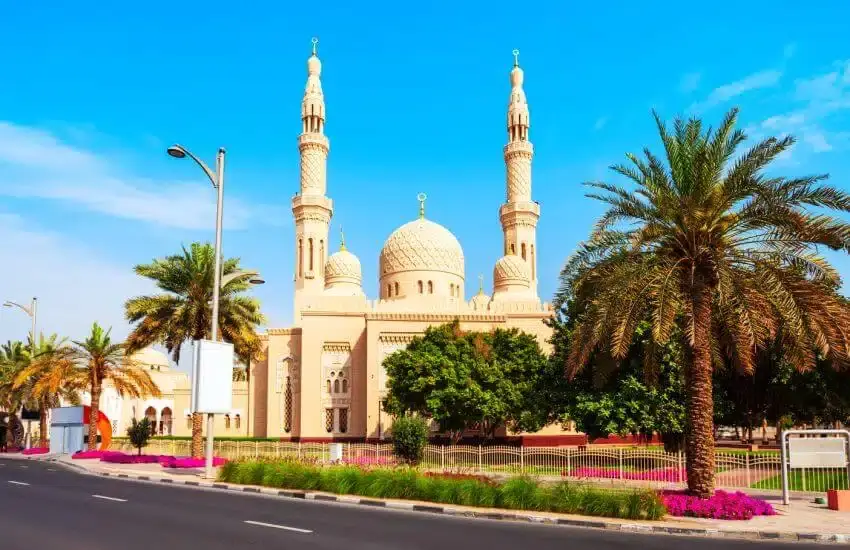
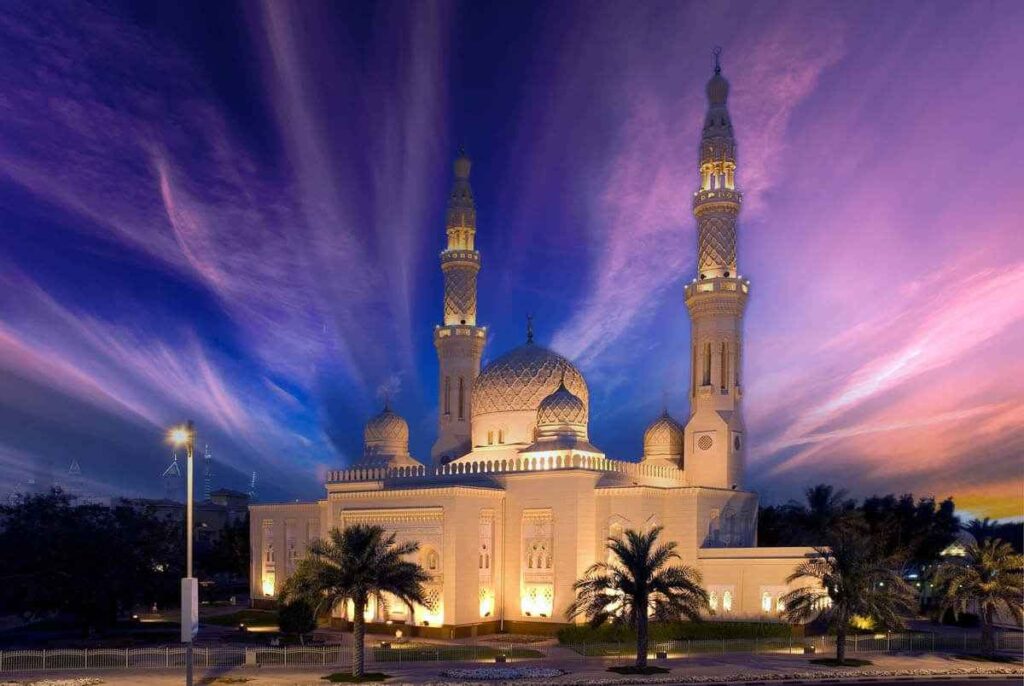
Constructed from light-colored stone (often described as white or pale sandstone), Jumeirah Mosque is instantly recognizable for its symmetrical façade, dominated by:
- A large central dome
- Two tall twin minarets
- Deep relief stone carvings
While official narratives often describe the mosque as purely Fatimid in style, architectural analysis reveals strong Mamluk influences, particularly in the minaret detailing and carved ornamentation—both traditions historically rooted in Cairo.
The mosque has two distinct entrances:
- A tourist entrance along Jumeirah Beach Road
- A worshippers’ entrance, featuring Quranic epigraphy from Surah At-Tawbah, emphasizing the obligation of prayer
An outer courtyard includes traditional ablution fountains (wudu), reflecting classical mosque planning.
Interior Architecture & Symbolism
Inside, the mosque follows a hypostyle layout, with columns arranged around the central dome—an architectural system used historically by Seljuk and Mamluk builders.
Key interior features include:
- A vast prayer carpet with floral Islamic motifs
- Quranic inscriptions featuring the Victory Verse, commonly associated with state-sponsored religious buildings
- Layered color symbolism:
- Earth tones (beige, yellow, salmon pink) at lower levels
- Blue tones ascending toward the dome, symbolizing the sky
Scholars and designers have noted visual parallels between Jumeirah Mosque’s interior ornamentation and the Alhambra in Spain, particularly in its color hierarchy and ornamental restraint—an uncommon reference in Gulf mosque architecture.
Recommended: Mall of the Emirates
Cultural Role: The SMCCU & “Open Doors. Open Minds.”
What truly distinguishes Jumeirah Mosque is its role as a living classroom. The mosque operates under the guidance of the Sheikh Mohammed Centre for Cultural Understanding (SMCCU), whose philosophy—“Open Doors. Open Minds.”—has become internationally recognized.
Guided Cultural Tours
Tours are conducted six days a week (Saturday to Thursday) and are designed for visitors of all faiths.
Tour Highlights:
- Explanation of the Five Pillars of Islam
- Demonstration of ablution (wudu)
- Overview of daily prayers and mosque etiquette
- Discussions on Ramadan, fasting, Islamic holidays, and Emirati customs
- Open Q&A sessions where no respectful question is off-limits
Tours are led by Emiratis and residents from diverse cultural backgrounds, reinforcing Dubai’s multicultural identity.
Light refreshments—Arabic coffee, dates, and snacks—are included, reflecting traditional hospitality.
Recommended: Ski Dubai
Visitor Information & Practical Details
Location
📍 Jumeirah Beach Road, Jumeirah 1, Dubai, UAE
Visiting Hours
- Open daily to visitors from 10:00 AM – 8:00 PM
- Guided tours: 10:00 AM & 2:00 PM (Saturday–Thursday)
- Closed for public tours on Fridays
Entry Fees
- General mosque entry: Free
- SMCCU guided tour: Approx. AED 45, including refreshments
Dress Code
- Modest clothing required
- Long sleeves and full-length trousers or skirts
- Women must wear a headscarf
- Traditional attire is provided free of charge
Footwear is removed before entering the prayer hall.
Accessibility & Transport
Jumeirah Mosque is not directly connected to the Dubai Metro, but it remains accessible via public transport:
- Metro: Red Line → Max Station
- Bus: X28 to Jumeirah, Grand Masjid stop
- Walk: Approximately 4 minutes
Taxis and ride-hailing services such as Careem and Uber are widely used by visitors.
Nearby Attractions & Extended Exploration
Visiting Jumeirah Mosque pairs naturally with nearby cultural and leisure destinations:
- Etihad Museum – UAE history and constitution
- La Mer – dining, art murals, and beachfront access
- Mercato Mall – Italian-inspired shopping center
For travelers building a deeper itinerary, aboutdubai.online also provides detailed guides to nearby cultural landmarks, traditional souks, and historic districts across Dubai.
Why Jumeirah Mosque Matters Today
In a city often defined by speed and scale, Jumeirah Mosque represents intentional slowness and understanding. It is not merely photographed—it is explained. Not merely visited—it is interpreted. Its continued relevance lies in its ability to translate Islamic practice into human experience without dilution or spectacle.
This balance between authenticity and accessibility is why Jumeirah Mosque remains one of Dubai’s most meaningful cultural institutions.
Recommended: Dubai Mall
Frequently Asked Questions (FAQ)
Is Jumeirah Mosque open to non-Muslims?
Yes. Jumeirah Mosque is one of the few mosques in Dubai that welcomes non-Muslim visitors through guided tours organized by the SMCCU.
Is Jumeirah Mosque worth visiting?
Absolutely. It offers rare, structured access to Islamic culture in a respectful and educational setting, making it especially valuable for first-time visitors to the UAE.
What should I wear when visiting Jumeirah Mosque?
Visitors should dress modestly with full coverage. Women must wear a headscarf. Traditional clothing is provided on-site if needed.
Is photography allowed inside Jumeirah Mosque?
Yes, photography is generally permitted during guided tours.
How long does the tour take?
The standard SMCCU tour lasts approximately 75 minutes.
Is Jumeirah Mosque the biggest mosque in Dubai?
It is among the largest and most prominent, accommodating around 1,200–1,500 worshippers, though other mosques may surpass it in total area.
Can children join the tour?
Yes. The mosque and SMCCU offer age-appropriate explanations, making it suitable for families.
Final Perspective
Jumeirah Mosque is not just an architectural landmark—it is a cultural interface between Dubai and the world. For travelers who want to understand the values shaping Emirati society, rather than simply observe them from a distance, this mosque remains one of the city’s most essential experiences.